
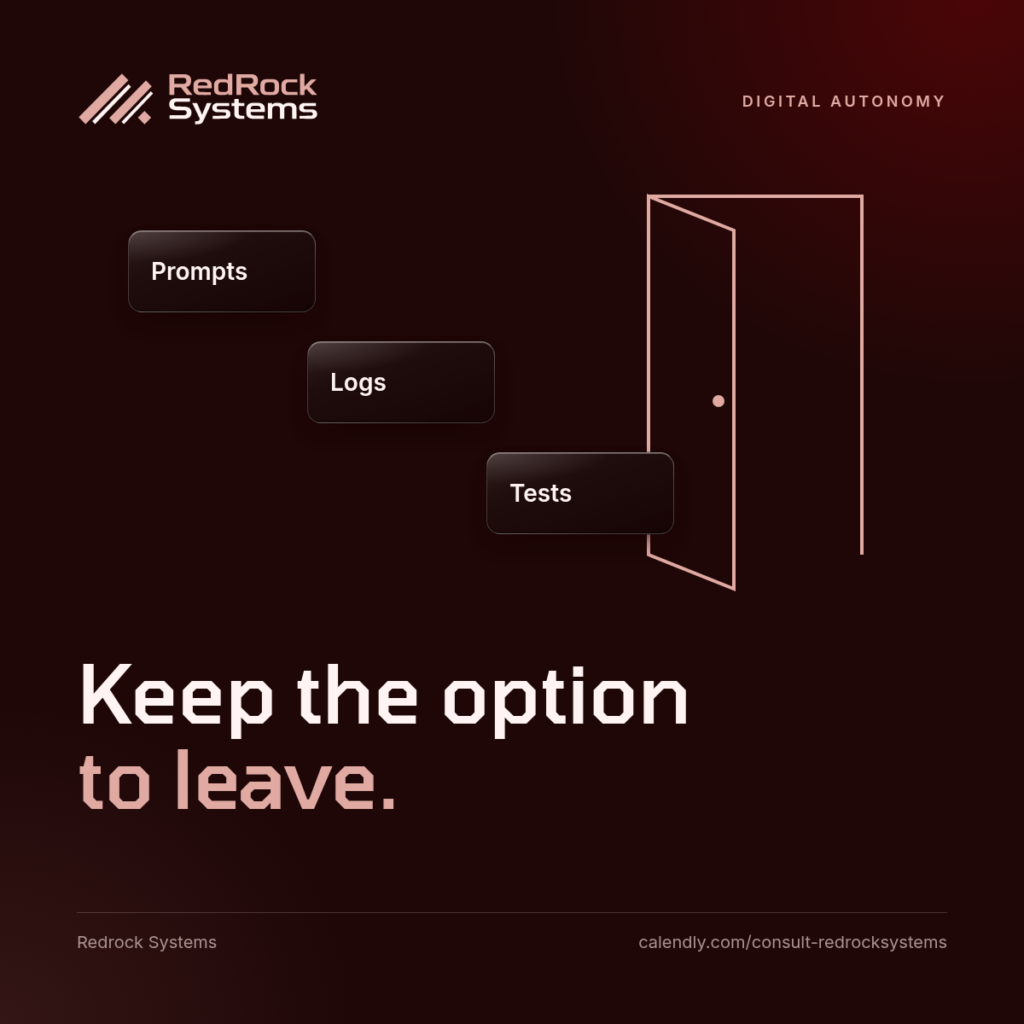
Ask a simple question about any AI system in your business: if you had to switch vendors next quarter, what would you take with you?
For many companies, the honest answer is very little. The prompts were written inside the vendor’s console. The test results live in the vendor’s dashboard. The logs sit in the vendor’s cloud. The system works, but you do not fully own it.
That matters more each month. New models arrive often. Prices change. Terms change. A vendor that fits today may not fit next year. The option to leave is part of owning your AI, and it is a choice you make on day one, not a request you make at exit.
| What you should own | Why it matters | Where it should live |
|---|---|---|
| Prompts and instructions | They encode how your business works | Your own repository, under version control |
| Evaluations and test sets | They prove a new model is good enough | Your own repository, runnable anywhere |
| Logs and decisions | They show what the system did and why | Your own storage, in an open format |
| Business data | It is the reason the system has value | Your systems, shared with vendors by contract |
Lock-in rarely looks like lock-in
No one signs a contract that says “you can never leave.” Lock-in builds quietly through convenience.
A team writes its best prompts in a vendor playground because it is fast. Another team uses the vendor’s built-in evaluation tool, so the test cases exist only there. Conversation history is stored by default in the vendor’s platform. Each choice is reasonable on its own. Together, they mean the most valuable parts of your AI system belong to someone else’s product.
When it is time to switch, the cost is not the new license. It is rebuilding everything you learned.
Prompts are business logic
A well-tuned prompt is not a throwaway string. It captures your tone, your policies, your escalation rules, and the edge cases your team discovered the hard way. In a bank or an insurer, it may encode how the system talks about fees, claims, or eligibility.
Treat prompts the way you treat code. Keep them in your own repository. Review changes. Record which version ran in production on which day. If a regulator, an auditor, or a customer asks why the system said something, you want that history in your hands.
Your tests are your exit ticket
The single most useful asset for switching vendors is a set of evaluations you own: real examples from your business, with the answers you expect, that you can run against any model.
With that in place, a new model or a new vendor becomes a test run. You compare results on your own cases, see where the new option is better or worse, and decide on evidence. Without it, every switch is a leap of faith, so most teams never switch at all.
The same tests protect you when you stay. Vendors update models. Your evaluations are how you notice a change in behavior before your customers do.
Logs and data stay yours
Logs show what your AI system read, what it said, and when a person stepped in. They are the record you will need for audits, disputes, and improvement. Store them in your own systems, in a format you can read without the vendor’s tools.
Business data deserves the same care. Know what you send to each vendor, whether they keep it, and whether they train on it. Read the exit terms before you sign: how you get your data back, in what format, and how fast.
Portability is a design choice
None of this means avoiding vendors. It means designing so that a vendor is a part you can replace, not the foundation you stand on. A few choices are designed to keep that option open:
- A thin layer between your systems and any model, so swapping a provider is a configuration change, not a rewrite.
- Prompts, evaluations, and policies in your repository, not only in a vendor console.
- Logs in your storage, in open formats.
- Contract terms that cover data return, retention, and training use.
Done early, this costs little. Done at exit, it costs a project.
Know your exit before you need it
If you are not sure what you could take with you today, that is the place to start. One of our architects can map your current AI systems, show where prompts, tests, logs, and data actually live, and design the changes that keep the option to leave in your hands.