
Moving fast with AI is not the risky part. Shipping what nobody checked is.
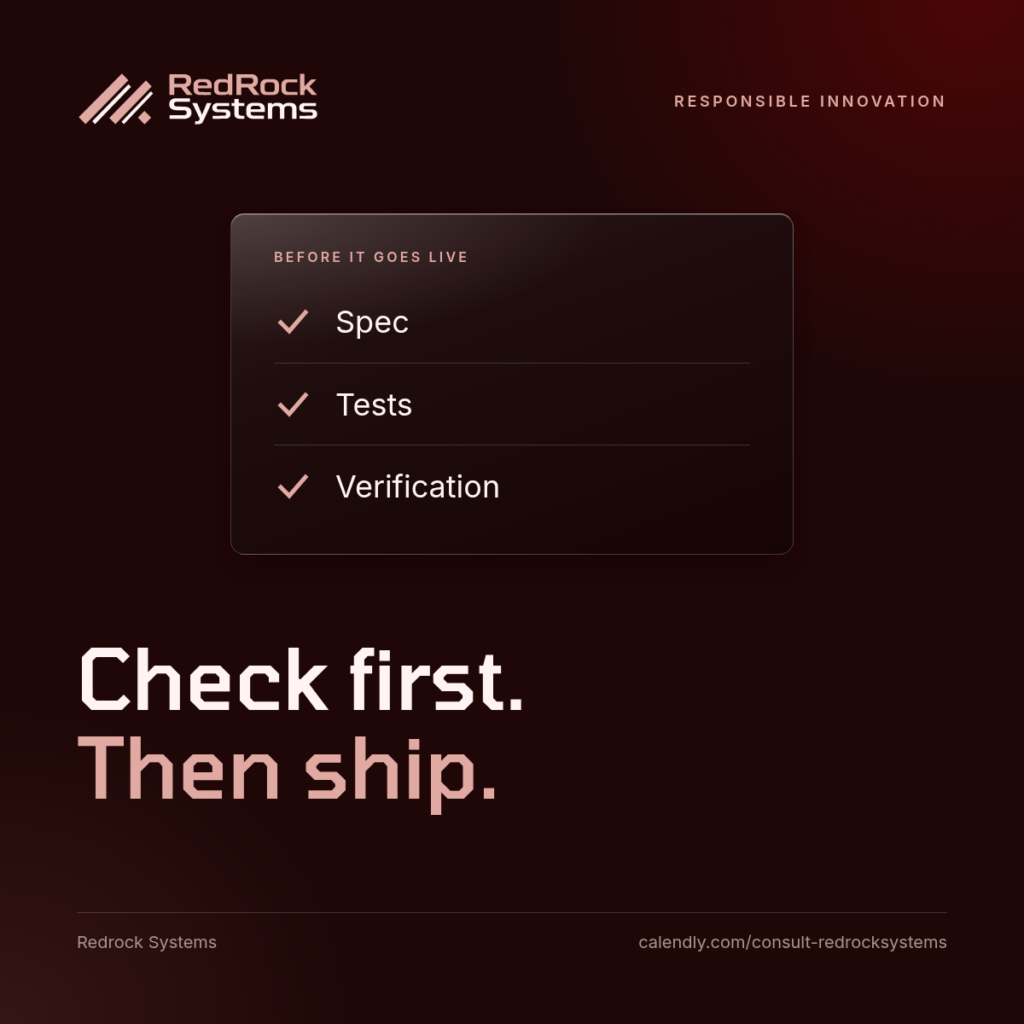
Agents now write code, draft policies, answer customers, and change systems. They do it quickly and with confidence. Confidence is not evidence. Responsible innovation means the checks come first: a clear spec of what the work should do, tests that show it does, and verification proportional to what is at stake.
| Check | The question it answers | Who owns it |
|---|---|---|
| Spec | What exactly should this do, and not do? | The business owner, with an architect |
| Tests | Does it do that on real cases? | Engineering, with business examples |
| Verification | Can we show it holds, beyond the cases we tried? | Architecture, for the highest-risk parts |
| Release gate | Who says yes before it goes live? | A named person, every time |
The bug is often in the instructions
An agent builds what it is told. If the instructions are wrong, it builds the wrong thing faithfully.
At AI Engineer on November 11, 2026, Rajath Mahendrappa Kotyal of AWS gave a short talk titled “Your Spec Has Bugs. Catch Them Before Your Agent Codes.” His example was simple. One rule in an e-commerce spec said to place an order on backorder when inventory is unavailable. Another rule in the same spec said no order may be placed on backorder. Each reads sensibly alone. Both cannot be true at once.
His approach pairs a language model with a logic solver to find rules that conflict, cases no rule covers, and sentences with two meanings, before any code is written. He was clear about the limit: the people who own the requirement still decide what it should mean.
That is the right order of work. Fix the spec while a change costs a conversation, not a release.
Your Spec Has Bugs. Catch Them Before Your Agent Codes.
Verification is becoming practical
For most software, formal verification, proving mathematically that code does what it should, has been too expensive outside a few critical systems. That may be changing.
On November 10, 2026, Google DeepMind published AlphaProof Code, a framework that uses AI agents to help write formal specifications and then prove that real code meets them. DeepMind reports that it used the framework to prove key security properties of the compiled code behind the Signal protocol, with human experts reviewing every specification and every proof checked by the Lean proof assistant. To test it, the team reintroduced two real, previously fixed bugs into an isolated copy of the code, and the system showed that the buggy version was insecure.
Introducing AlphaProof Code (Google DeepMind)
Two lessons carry over to any business, whether or not you ever use formal methods:
- People decide what to prove. The spec came first, and humans reviewed it.
- Machines check the work. Nothing counted as proven until an independent checker accepted it.
What this means for agents in your business
Most companies do not need a mathematical proof for every workflow. They do need checks that match the risk.
- A customer-facing answer about a fee, a claim, or a rate needs a spec of what the agent may say and a test set built from real questions.
- A code change generated by an agent needs tests that existed before the change, not tests the agent wrote to pass its own work.
- A model or vendor upgrade needs the same test set run again before the switch.
- The most critical paths, such as payments, access control, and safety logic, deserve deeper verification and a human release gate.
The order matters more than the tools. Spec, then tests, then verification, then release.
Build the gate once
The teams that move fastest with AI are often the ones with the strongest gates, because they can trust each release without a long debate. A Baseline engagement is built to put that gate in place: clear specs for your highest-risk agent work, test sets drawn from your business, and a release process with a named owner.