
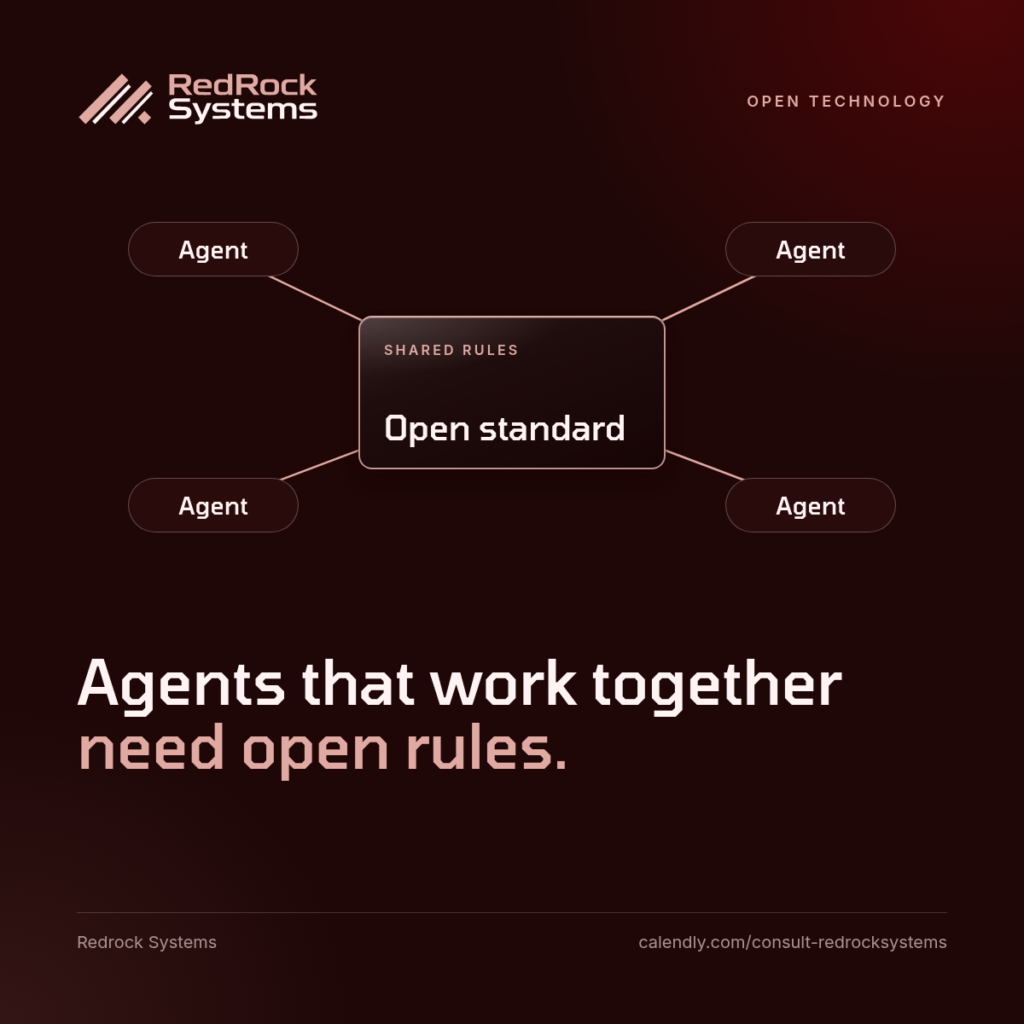
Most companies now run more than one AI agent. Customer service has one. Operations has another. Risk, finance, and marketing are building their own. Each was built by a different team, on a different tool, with its own rules for what data it may read and how it hands work to a person.
The result is a set of islands. Each agent may work well alone. Together, they cannot share context, pass work cleanly, or follow one set of rules. That is not a model problem. It is a missing agreement on how agents behave.
| Where agents need shared rules | What breaks without them | What an open rule gives you |
|---|---|---|
| Data access | Each agent gets its own, often broad, connection | One policy you can read, review, and enforce |
| Handoffs | Work and context are lost between agents and people | A known format for passing a task along |
| Boundaries | Limits live inside each agent’s prompt | Limits enforced around the agent, in infrastructure |
| Content origin | No one can tell what a machine produced | Provenance that travels with the file |
The problem is not a shortage of agents
In a recent AI Engineer talk, Justin Schroeder observed that everybody is building agents, and that one team’s custom agent usually cannot be shared or combined with another team’s in any simple way. His talk title says it directly: “Every Company Is Building Agents That Can’t Work Together.”
Every Company Is Building Agents That Can’t Work Together
You do not need to adopt any one company’s answer to see the business problem. If a bank’s service agent cannot hand a fraud signal to its risk agent with the right context, a customer waits, or worse, the signal is lost. If a hotel group’s booking agent and its loyalty agent follow different rules for guest data, someone will eventually get a wrong answer.
Boundaries belong outside the agent
A prompt that says “do not read payroll data” is a request, not a control. Real limits on what an agent may reach need to be enforced around it, where the agent cannot talk its way past them.
The open source community is moving in this direction. On November 10, 2026, at KubeCon + CloudNativeCon North America, the Cloud Native Computing Foundation welcomed OpenShell as a Sandbox project, contributed by NVIDIA. The CNCF describes it as an open source runtime for securing and governing autonomous agents, with policy-based boundaries enforced in the infrastructure the agents run on. The project says it is adopting Cedar, another CNCF project, as its policy language, and it has moved to neutral governance with a public RFC process.
Welcoming OpenShell to the CNCF (CNCF blog)
The point for a business leader is not this one project. It is the pattern: rules for agent access are becoming something you can write down, inspect, and run under open governance, instead of something buried inside each vendor’s product.
Open rules matter for creative work too
Agents do not only move data. They produce text, images, audio, and video. When that content travels, the people who receive it, and the artists whose work is involved, deserve to know where it came from.
C2PA, the Coalition for Content Provenance and Authenticity, publishes an open technical standard for Content Credentials: a way to attach a record of origin and edits to a media file (c2pa.org). When your systems create or edit content, supporting that standard is designed to let others see that a machine was involved, and it is one way to respect the people whose work shapes what AI produces.
Provenance is a shared rule in the same sense as data access. It only works if many systems can read it.
What open rules look like in practice
You do not need to wait for the industry to settle every standard. A few choices are designed to keep your agents from becoming islands:
- One written policy for data access, enforced outside the agents, instead of a separate set of permissions inside each one.
- A common handoff format for passing a task, its context, and its history between agents and people.
- Open formats for logs, so any team, auditor, or future vendor can read what happened.
- Content Credentials on media your systems produce, where your tools support them.
- A preference for open standards and open governance when you choose between otherwise similar tools.
Each choice makes the next agent easier to add, and the next vendor easier to replace.
Map the islands first
Before you build another agent, find out how the current ones connect, or fail to. A diagnostic is built to map your agents, the data each one touches, the handoffs between them, and where shared rules would remove the most risk.